Stage 3
This crowdsourced website launched in August 2026, and much of its information is currently placeholder content. We’re asking mail carriers to help us identify errors and submit corrections as we add practical, professional insights from experienced carriers to every page.
A few paragraphs down the page, Joanie Weber re-reads the first part of the poster titled The Journey of a Piece of Mail by Molly Hunter, because that section is presented as a flowchart. While computers are very good at creating flowcharts, they are not always very good at reading them aloud in a clear and natural way. Joanie is stepping in to make sure the information is easier to follow and understand. She hopes you enjoy the content.
Every piece of mail you carry follows the same journey — from your case, to a decision at the door, to (hopefully) a mailbox. This guide walks through that whole day: your morning and evening duties, how to decide whether a piece can be delivered, the endorsements you'll use, and the safety habits that protect you the entire time.
From casing to delivery — daily duties, the delivery decision tree, common endorsements, and the safety habits that keep you protected.
Podcasters' Wisdom Podcasts - Listen Again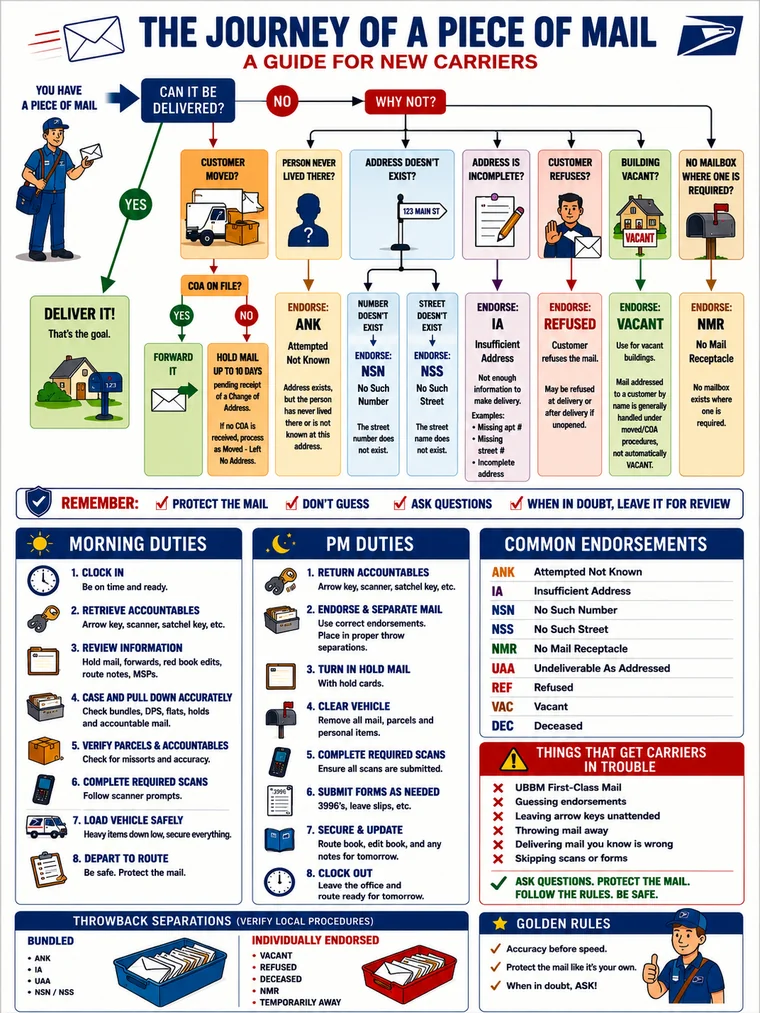
Courtesy of Molly Hunter
☀️ Morning Duties
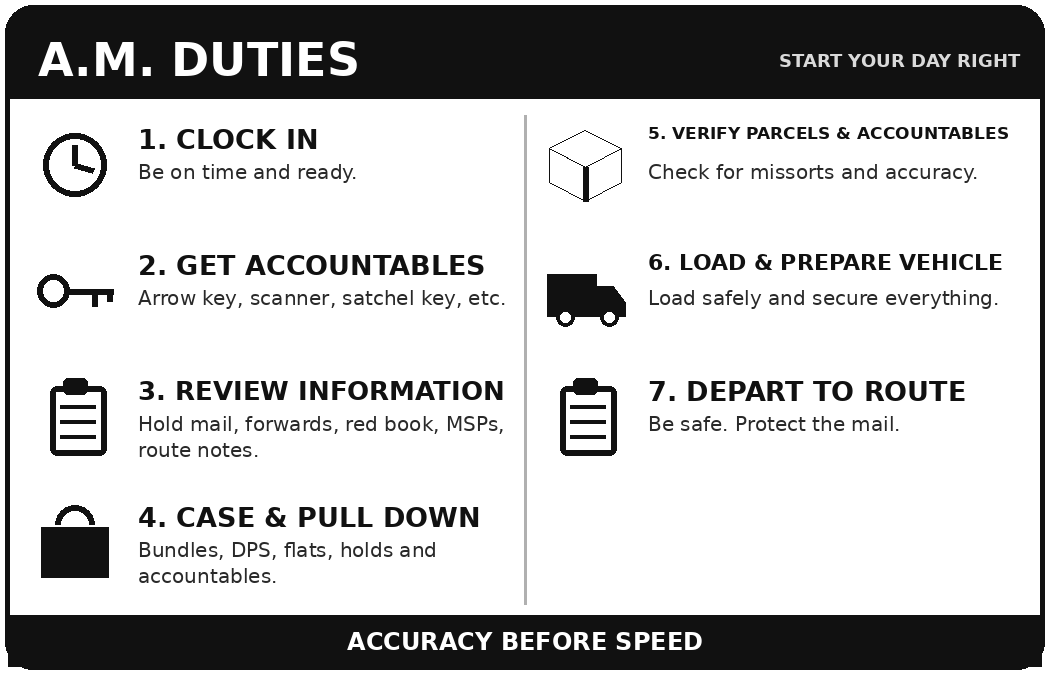
- Clock In — Be on time and ready.
- Get Accountables — Arrow key, scanner, satchel key, etc.
- Review Information — Hold mail, forwards, red book, MSPs, route notes.
- Case & Pull Down — Bundles, DPS, flats, holds and accountables. 🎧 Bonus Content!
- Verify Parcels & Accountables — Check for missorts and accuracy.
- Load & Prepare Vehicle — Load safely and secure everything.
- Depart to Route — Be safe. Protect the mail.
Accuracy before speed.
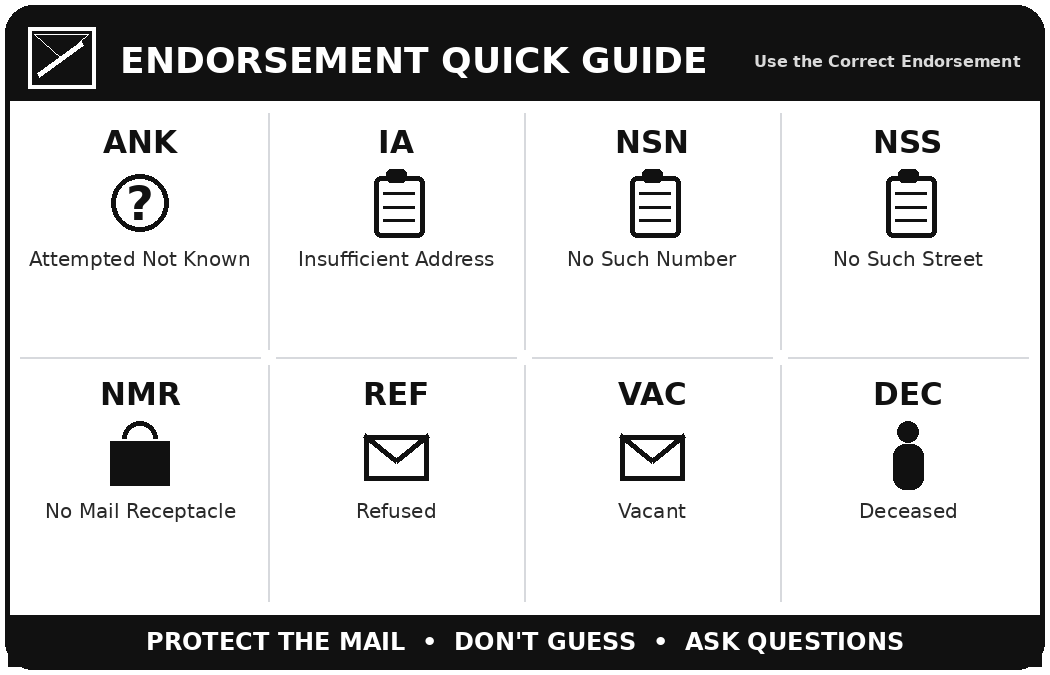
🏷️ Common Endorsements
A quick-reference glossary for every code you'll see on a case or a scanner prompt:
🧺 Throwback Separations
Verify local procedures — how these are separated can vary by station.
- Bundled: ANK, IA, UAA, NSN/NSS (Bundled means only endorse the top item in that stack)
- Individually endorsed: Vacant, Refused, Deceased, NMR, Temporarily Away (Individually Endorsed means endorse each item)
⚠️ Things That Get Carriers in Trouble
- UBBM First-Class Mail - Putting first class mail in the recycling UBBM tub.
- Guessing endorsements
- Leaving arrow keys unattended
- Throwing mail away - Duh.
- Delivering mail you know is wrong. You delivered mail to the wrong house and when you realize it you don't go back and correct it.
- - Skipping scans or forms - CRM scans - When your scanner gives you a CRM request, do it. (Does anybody know what CRM stands for? We can't find it.)
Ask questions. Protect the mail. Follow the rules. Be safe.
🌙 Evening (PM) Duties
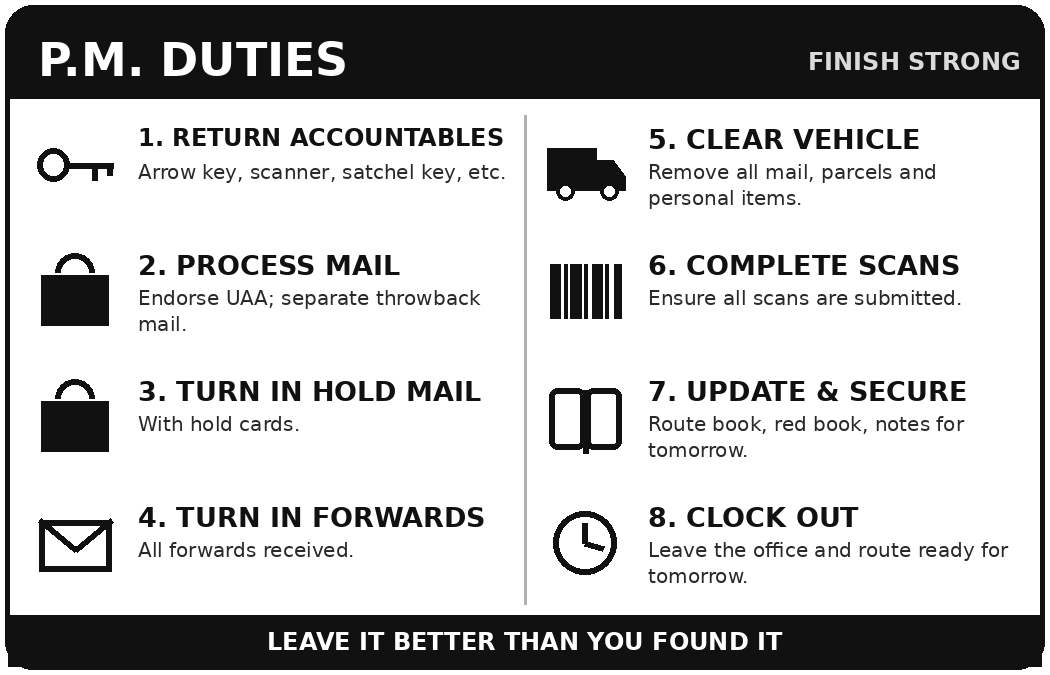
- Return Accountables — Arrow key, scanner, satchel key, etc.
- Process Mail — Endorse UAA; separate throwback mail.
- Turn In Hold Mail — With hold cards.
- Turn In Forwards — All forwards received.
- Clear Vehicle — Remove all mail, parcels, and personal items.
- Complete Scans — Ensure all scans are submitted.
- Update & Secure — Route book, red book, and notes for tomorrow.
- Clock Out — Leave the office and route ready for tomorrow.
Leave it better than you found it.
🛡️ Safety First: Every Choice Matters
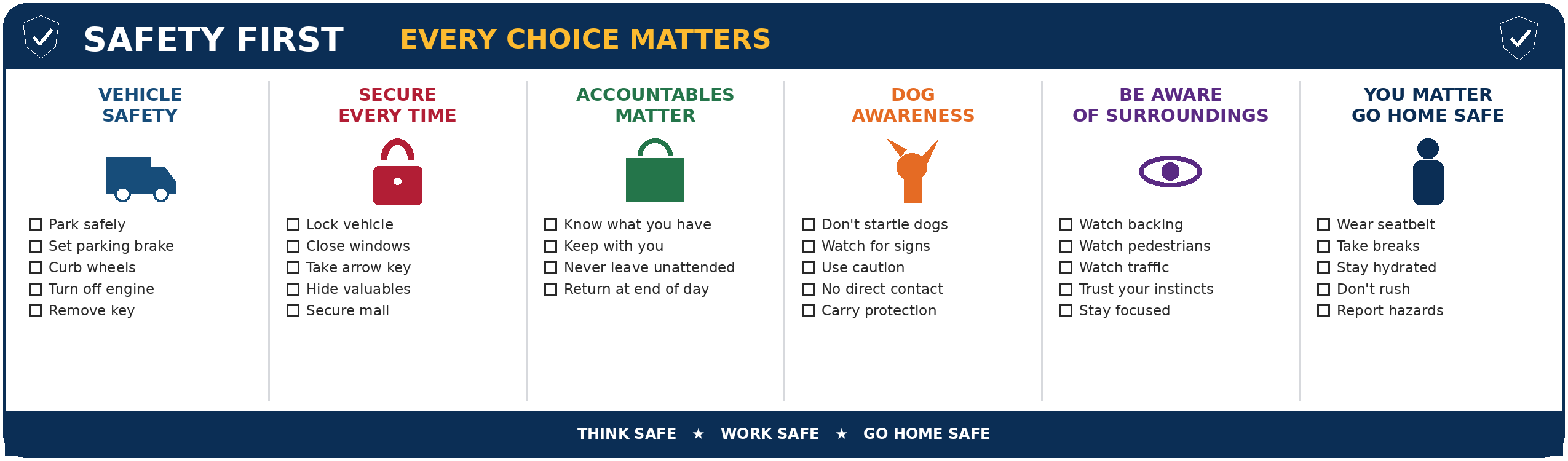
🚚 Vehicle Safety
- Park safely
- Set parking brake
- Curb wheels
- Turn off engine
- Remove key
🔒 Secure Every Time
- Lock vehicle
- Close windows
- Take arrow key
- Hide valuables
- Secure mail
🔑 Accountables Matter
- Know what you have
- Keep with you
- Never leave unattended
- Return at end of day
🐕 Dog Awareness
- Don't startle dogs
- Watch for signs
- Use caution
- No direct contact
- Carry protection
👀 Be Aware of Surroundings
- Watch backing
- Watch pedestrians
- Watch traffic
- Trust your instincts
- Stay focused
❤️ You Matter, Go Home Safe
- Wear seatbelt
- Take breaks
- Stay hydrated
- Don't rush
- Report hazards
Think safe. Work safe. Go home safe.
📢 Safety Reminders
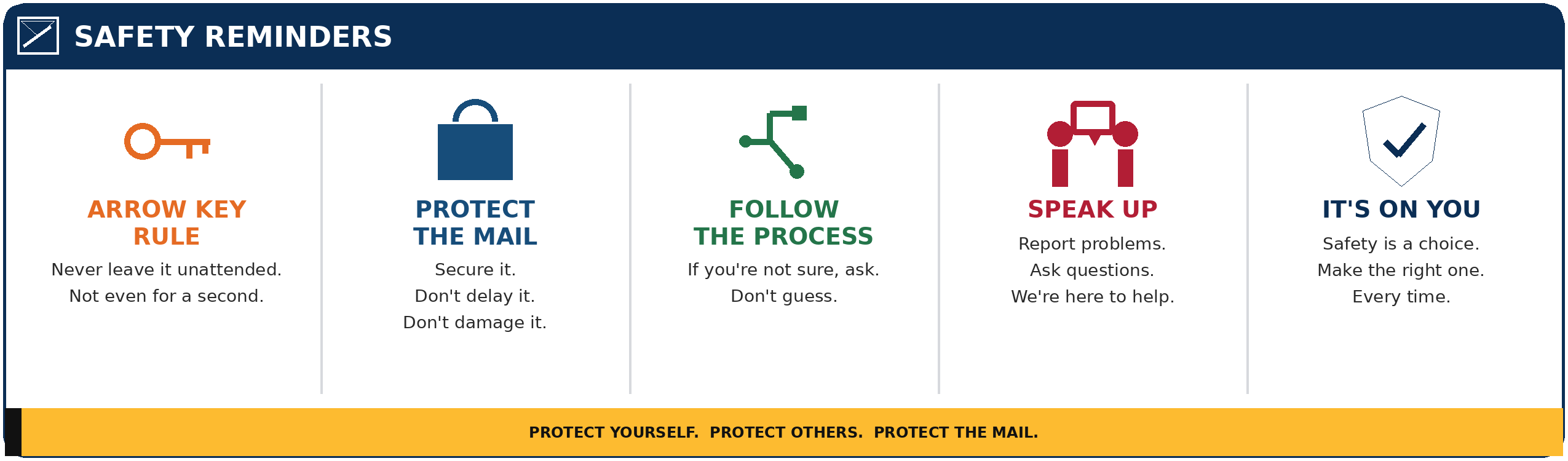
- Arrow Key Rule — Never leave it unattended. Not even for a second.
- Protect the Mail — Secure it. Don't delay it. Don't damage it.
- Follow the Process — If you're not sure, ask. Don't guess.
- Speak Up — Report problems. Ask questions. We're here to help.
- It's on You — Safety is a choice. Make the right one. Every time.
Accuracy before speed. Protect the mail like it's your own. When in doubt, ASK!
Download All the Cards
Every card on this page, full quality, in one ZIP file — handy for printing or sharing at the station.
⬇ Download All Cards (.zip)📝 Test Your Knowledge: Stage 3 Badge: Daily Duties, Endorsements and Safety
10 questions — 70% to pass, 80% Skilled, 90% Mastered, 100% Perfect.
💡 Want to make a comment?
Do you have an idea or way of doing things that you would like members to know about? Sign in to leave a comment and we might use your idea in our training and Union pages.
Sign in to Leave a CommentThis stage has 3 more parts below. Read on in order, and take each test as you reach it: it opens on the course's own page and brings you back here when you're done.
Daily Procedures, Habits & Routines
Your day from clock-in to clock-out — office prep, street delivery, schedule, breaks, and the daily habits that protect your time.
🧭 Overview
As a City Carrier Assistant (CCA), daily duties split into two major categories: office work and street delivery. Mastering both protects your time and route while supporting job success.
🏢 Office Duties
Before heading to the street, office time typically includes:
- Casing Mail – Sorting flats and letters into your route's case, organizing SPRs and manual flats
- Pull Down – Once casing is complete, pulling down mail and preparing it for the route
- Loading the LLV – Properly loading your truck (or satchel) in delivery order to minimize time lost on the street
- Scanner Setup – Confirming your scanner is ready, battery is charged, and all barcodes are functioning
- Clock Rings – Making sure "Begin Tour" and "Leave to Street" are logged in TACS through the MDD scanner
🚶 Street Duties
Once you leave the building and hit "Leave to Street," focus shifts to efficient and safe mail delivery:
- Route Familiarization – Walking or driving the route with an OJI to learn turns, patterns, and hazards
- Follow the Line of Travel – Deliver in the exact sequence shown on the case and scanner, even if skipping around feels faster. Use relay bags on walking routes; park safely and legally — never block driveways or hydrants
- Parcels and SPRs – Scan and deliver parcels and Special Purpose Route mail when prompted. If a delivery can't be made, attempt once, leave PS Form 3849 ("We ReDeliver for You!"), and mark "No Access" or "Attempted" with a reason in the scanner
- Scanner Use – Clocking events, MSP scans, package tracking, and logging delivery attempts
- Street Safety – Watch for dogs (carry spray, never enter fenced yards uninvited), watch traffic when crossing or exiting the LLV, use handrails and walkways, and never run
- Pace – Don't feel pressured to rush; focus on consistency and safety. If you'll need more time, submit PS Form 3996 before leaving the office
🕐 Your Schedule, Breaks & Daily Habits
A steady daily routine protects your time and keeps you safe. Build these habits from day one:
- Reporting to work – Arrive at your assigned report time in uniform, ready for instructions, and hit "Begin Tour" on your MDD scanner to start your workday
- Lunch – CCAs get an unpaid lunch (usually 30 minutes). Scan "Begin Lunch" and "End Lunch," and take it at the time and place assigned. If your schedule is disrupted, talk to management before skipping or delaying lunch
- Comfort (rest) breaks – Generally a paid 10-minute break in each half of your shift (per local practice/MOU). These aren't scanned but should be taken responsibly; report it if conditions prevent a break
- Communicate delays early – If you'll run late, tell your supervisor before your expected return time, and use PS Form 3996 to request overtime or auxiliary help
The time-related scan events that anchor your day: Begin Tour → Leave to Street → Begin/End Lunch → Return to Office → End Tour.
🧾 Stand-Up Talks & Daily Communication
Most days begin with a stand-up talk — a short (2–5 minute) briefing from your supervisor covering safety, scanner procedures, weather precautions, holiday plans, or policy changes. They're usually read aloud and posted for reference.
- Listen and note – Many talks tie directly to safety and discipline. Write down anything that affects your route or duties for your records, and ask for clarification afterward if something is unclear
- Report hazards – If you spot an unsafe condition (damaged LLV, aggressive animal, blocked walkway), fill out PS Form 1767 or notify your supervisor immediately
- Speak up respectfully – Be calm and specific when raising concerns, and request a union steward if you're asked to do something unsafe or questionable. You're not expected to know everything — you're expected to ask questions and protect your safety and time
⚖️ Why Office vs. Street Time Matters
During route inspections, USPS compares office and street time against established standards. To protect yourself:
- Record clock rings accurately
- Use PS Form 3996 if expecting overtime or needing help
- Log delays, hazards, or issues with PS Form 1571 or a daily log
🧾 Helpful Forms and Tools
- PS Form 1838-C: Tracks casing time and delivery time for route evaluations
- PS Form 3996: Request for overtime or auxiliary assistance
- PS Form 1571: Curtailment report if mail couldn't be delivered or cased
Your schedule, breaks, and a steward's help aren't favors — they're rights. Know the essentials in Basic Rights & USPS Worker Policies, including your Weingarten right to a steward in any interview that could lead to discipline.
Dig deeper with Casing Mail, Street Delivery Basics, Clock Rings Basics, and Scanner Use.
📝 Test: Daily Procedures, Habits and Routines Badge
Ten questions, 70% to pass. You can take it now; sign in to keep the score.
Take the test →Forms and Logs
The USPS forms and personal logs every CCA should know — and how to use them.
📄 USPS Forms & Logs for City Carrier Assistants
Documentation accuracy is essential for CCAs. This page explains the key forms for requesting assistance, reporting hazards, tracking performance, and protecting your work time.
📋 Key Forms You'll Use at the Station
PS Form 3996 — Carrier Auxiliary Control
- Purpose: Requesting overtime or auxiliary help when you won't complete your assignment in time.
- Timing: Submit before leaving the office if help is anticipated.
- Availability: Request from your supervisor; not publicly downloadable.
- Recommendation: Note your reasons and request copies for your personal records.
PS Form 1571 — Undelivered Mail Report
- Use: Reporting mail curtailment or items you were unable to deliver that day.
- Significance: Protects carriers from blame for undelivered items.
- Access: Request from your supervisor; not publicly available online.
PS Form 1838-C — Carrier's Count of Mail
- Function: Documents mail volume, office time, and street time during route inspections.
- A training resource is available as a fillable PDF.
PS Form 4565 — Vehicle Repair Tag
- Purpose: Reporting a defect on your vehicle — anything you find wrong with it, from a wiper blade to brakes that don't feel right.
- Timing: When you find it — on your inspection before you pull out, or out on the street — and turn the tag in to your supervisor.
- Reference: Handbook M-41, §842.
PS Form 1767 — Report of Hazard
- Purpose: Reporting an unsafe condition or practice — a dangerous spot on the route, an aggressive animal, an unsafe way of doing the work.
- Not the form for a vehicle defect — that's the 4565 above. A vehicle can be unsafe enough to be worth a hazard report too, but the repair itself is the tag's job.
- Publicly downloadable as a PDF.
✅ Publicly Available USPS Forms
- PS Form 3971: Requesting annual or sick leave.
- PS Form 3849: Left-at-door notice for failed delivery attempts.
- PS Form 1260: Manual time recording when electronic clocking is unavailable.
🧾 Training Logs & Personal Records
A fillable Letter Carrier Daily Log template helps you track clock rings, break times, forms submitted, delays, and unusual occurrences.
📚 Related Pages
When in doubt, write it down. A 3996 before you leave, a 1571 for curtailed mail, a 4565 for anything wrong with the vehicle, and a 1767 for a hazard create a paper trail that protects your time, your route, and your safety.
📝 Test: Forms and Logs Badge
Ten questions, 70% to pass. You can take it now; sign in to keep the score.
Take the test →Stand-Up Talks & Communication
Daily station briefings — what they cover and how to speak up respectfully.
🧾 Stand-Up Talks & Communication
Every day in the Postal Service begins with communication. Whether it's a quick safety reminder or a new delivery procedure, stand-up talks are a core part of USPS station life. As a CCA, understanding these talks — and knowing how to speak up respectfully — helps you stay informed, safe, and confident.
📣 What Are Stand-Up Talks?
- Short (typically 2–5 minute) announcements delivered by your supervisor at the start of the workday.
- Cover topics like heat safety, scanner procedures, holiday service plans, or recent USPS policy changes.
- Stand-up talks are usually required to be read aloud and posted for carrier reference.
Tip: Listen carefully. Many stand-up talks are directly tied to workplace safety and discipline. If you're unclear, it's okay to ask for clarification afterward.
🛠 Common Stand-Up Talk Topics
- Dog awareness and animal interference
- Vehicle safety and LLV procedures
- Package scanning expectations
- Weather-related precautions (heat, ice, lightning)
- Route adjustments and overtime updates
🧍 Your Role in Safety and Communication
You are expected to follow USPS safety rules and raise concerns when you encounter hazards. Here's how to handle it:
- If something sounds unclear or incorrect in a talk, ask your supervisor calmly after the talk concludes.
- If you spot unsafe conditions (damaged LLV, aggressive animal, blocked walkway), fill out PS Form 1767 or notify your supervisor immediately.
- Write down safety talks that affect your route or duties for your records. This helps if questions come up later.
💬 How to Communicate Effectively With Management
- Be calm, respectful, and specific when asking for help or clarification.
- Use forms when necessary — like PS Form 3996 for overtime or PS Form 1571 for curtailed mail.
- Request a union steward if you're unsure how to proceed or if you're being asked to do something unsafe or questionable.
You are not expected to know everything — you are expected to ask questions and protect your safety and time.
📚 Related Pages & Tools
- 🕒 Daily Schedule and Breaks
- 🆘 How to Get Help at Your Station
- 📘 Policies, Rights, and the National Agreement
- 📄 Forms and Logs (1767, 3996, 1571)
Stand-up talks are more than announcements — they're a record of what's expected of you. Stay alert, ask when in doubt, and take your role in communication seriously. It's how you stay safe, informed, and respected on the job.
No test for this course yet — read on to the next part.
Pass every test in this stage and its award is yours: Gold for an average of 90% or more, Silver 80, Bronze 70, Granite 60. Back to My Training.